



The Illusion of Control
Most men do not seek control because they are power hungry.
They seek control because control feels safer than trust.
It promises certainty.
It promises protection.
It promises outcomes.
That is why it is so appealing.
When life feels uncertain, control gives us the illusion that if we manage enough variables, anticipate enough problems, work hard enough, plan carefully enough, or worry long enough, we can prevent pain and guarantee the outcomes we want.
But control cannot deliver what it promises.
It cannot protect a marriage from hardship.
It cannot ensure children make wise decisions.
It cannot eliminate disappointment.
It cannot prevent loss.
And it certainly cannot control tomorrow.
At best, it creates the appearance of security.
Many men spend years trying to manage variables, predict outcomes, prevent disappointment, and avoid pain.
But eventually every man reaches a place where control no longer works.
A diagnosis.
A broken relationship.
A prodigal child.
A financial setback.
A betrayal.
A season of waiting.
And in those moments, God often reveals something we would rather not admit:
We were trusting our ability to manage life more than we were trusting Him.
Control promises certainty.
God asks for trust.
Why Isolation Feels Safer Than Healing
Most men know what they should do.
Talk about it.
Address it.
Confess it.
Ask for help.
Bring it into the light.
Yet many men do the opposite.
Why?
Because isolation often feels safer than healing.
Shame says:
If they knew the truth, they would think less of you.
Guilt says:
You created this mess. Fix it yourself.
Fear says:
If you talk about it, things will only get worse. And if you cannot forgive yourself for past mistakes, you may believe you deserve to carry the weight of them forever.
So the man withdraws.
He becomes quieter.
More guarded.
Less honest.
Less connected.
The tragedy is that isolation often feels like protection.
But what feels safe is often the very thing causing the damage.
The goal of fear is not fear.
The goal of fear is isolation.
The enemy rarely begins by convincing a man to abandon God.
He usually begins by convincing him to suffer alone.
A little distance from honesty.
A little distance from accountability.
A little distance from brotherhood.
A little distance from prayer.
A little distance from God.
Over time, that distance becomes isolation.
And isolation becomes a prison.
Two Different Types of Vulnerability
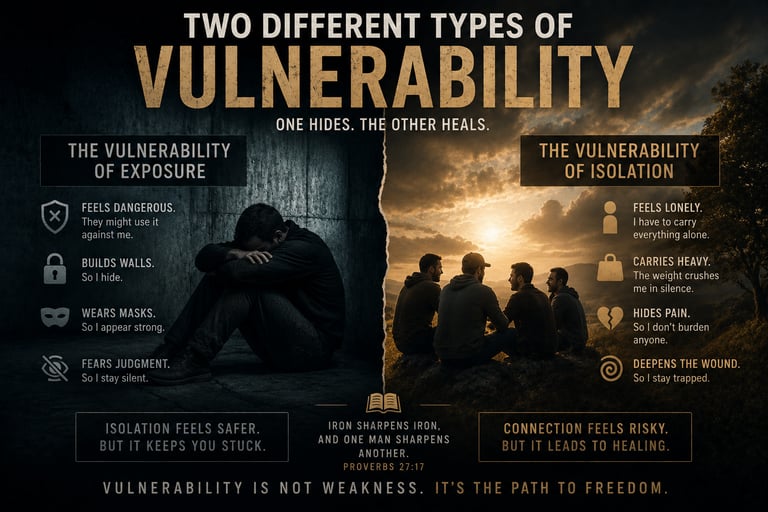
Many men hear the word vulnerability and immediately think of weakness.
But there are actually two very different forms of vulnerability.
The Vulnerability of Exposure
This is the vulnerability most men fear.
It sounds like:
If people know this about me, they can use it against me.
Maybe someone has betrayed your trust before.
Maybe you've been mocked, judged, rejected, or misunderstood.
Exposure feels dangerous.
And sometimes it is.
This fear causes many men to hide.
The Vulnerability of Isolation
Ironically, the man who hides is often far more vulnerable.
Why?
Because he is fighting alone.
No accountability.
No encouragement.
No perspective.
No correction.
No support.
No brotherhood.
Many men think vulnerability begins when they let people in.
In reality, vulnerability often begins when they shut everyone out.
Secrecy may protect a man from exposure.
But it also protects the fear that is controlling him.
God never intended men to fight alone.
Fear Faith Trust exists to help men identify the fears that influence their decisions, strengthen their faith through biblical truth, and develop a deeper trust in God.
If this article resonated with you, explore the other Hard Truths articles or continue your journey through Beneath the Surface.
When Disappointment Becomes Self-Protection
FEAR FAITH TRUST
Fear Is Rooted. Faith Is Chosen. Trust Is Lived.
© 2026 Fear Faith Trust. All rights reserved.
Privacy Policy | Copyright & Usage Policy | Contact
anchoredformation.com